Algorithmic Collusion: How Pricing Robots Learn to Rig Prices Without Talking
19 min read
There's a crime that needs two people in a room.
Two business owners meet for dinner. Over the second drink, one of them says the thing you're not supposed to say out loud: what if we both just stopped lowering our prices? They shake on it. They go home. Prices go up. Their customers pay more, and never find out why.
That handshake is the crime. Not the high prices, because high prices on their own are legal. The crime is the agreement. Two people deciding together to stop competing. That's what price-fixing is, and naked agreements of that kind between competitors are treated as illegal in themselves — no further argument about market effects required.
Prosecutors don't need the dinner on tape, either. An agreement can be inferred from how the parties behaved, from a pattern of dealing that makes no sense unless they had come to terms. But there is a line the courts have held for decades: parallel behaviour on its own is not enough. Everybody quietly matching everybody else's prices, each firm acting in its own interest and watching the others do the same, is not a conspiracy. It has a name — conscious parallelism — and it is lawful. Somewhere between "they clearly coordinated" and "they merely all did the same thing" sits the boundary of the offence.
Now take the two people out of the room.
Replace them with two pieces of software, the kind big companies already use to set prices automatically. One runs on Company A's computers. The other runs on Company B's. They never meet. Nobody told them to cooperate. They cannot send each other a message; there is no wire between them. The only thing either can see of the other is the price on the sign, the same thing any passing customer can see. Each was handed a single, boring, completely legal instruction: watch what's happening and set our price so we make as much money as possible.
Then you walk away and let them run.
Come back a while later, and here's what you find. Both prices are high. Held there, steadily, much higher than they should be when two companies are fighting for the same customers. And if you reach in and force one company's price down, to grab all the customers, the other company's price drops too, immediately, hard, like a slap. The two of them slug it out for a bit, both making less money, until the one who lowered first gives up. Then, quietly, both prices climb back up to the comfortable high level. As if nothing happened.
It looks exactly like the dinner-handshake cartel. Same high prices. Same punishment for breaking ranks. Same customers overpaying.
Except there was no dinner. No handshake. No agreement of any kind. The two programs never exchanged a single word, because they had no way to. Nobody, anywhere, decided to do this.
That is not a thought experiment. It is the central result of a 2020 paper in the American Economic Review by Emilio Calvano, Giacomo Calzolari, Vincenzo Denicolò and Sergio Pastorello, who set exactly this up and watched it happen.1 Their agents, they report, "consistently learn to charge supracompetitive prices, without communicating with one another," and the high prices are held in place by strategies with a punishment phase followed by a gradual return to cooperation.
That last sentence is the whole point of this piece, so let me slow down and show you how it's even possible. Because once you see how simple these programs actually are, it gets stranger, not less.
Why this is supposed to be impossible
Start with the thing everybody already understands.
Picture two shops next to each other selling the exact same bottle of water. Same brand, same size, nothing to choose between them except the price. You're going to buy from whichever one is cheaper. Obviously. Why would you ever pay more for the identical thing?
So put yourself in one shop owner's shoes. You're both charging ₹20. You think: I'll charge ₹19 and steal all his customers. Smart. But then he thinks the same thing and goes to ₹18. So you go to ₹17. He goes to ₹16.
Where does this stop? It stops when the price hits what the water actually costs you. Below that, every bottle you sell loses you money, so you can't go any lower. You've cut and cut and cut until there's basically no profit left in it for either of you.
That's the magic of competition, and it's the entire reason we like it. You don't need a thousand competitors to protect customers. You need two. Two is enough for them to claw each other's prices all the way down to the bone. The customer wins, the owners barely scrape by, and that's considered a healthy market.
So keep that picture in your head: two competitors should mean low prices and thin profits. Anything that ends with prices high and both companies fat and happy is supposed to be impossible.
Now I'm going to show you software walking straight out of that trap.
The program is dumber than you think
Here's where most explanations get vague and just say "the AI figures it out." Let me show you the actual thing, because it's nothing like the genius robot you're imagining.
Forget anything you've heard about AI that writes essays or holds conversations. This pricing program is far, far simpler. It is a technique called Q-learning, and it dates to 1989. The honest way to picture it is this.
Imagine a notebook. On the left side of each page, the program writes down a situation: "Last week my competitor charged ₹18 and I charged ₹17." Across the top, it lists every price it could pick this week. And in the little grid in between, it scribbles a single score for each option, its rough guess for "if I'm in this situation and I pick this price, how well will that go for me?"
At the start, the notebook is full of nonsense. Random scribbles. The program knows nothing. So it does the only thing it can: it tries stuff and keeps score. Most of the time it picks whichever price has the best score so far. But every now and then, just to avoid getting stuck, it tries a random price it wouldn't normally pick, just to see what happens. And after every week, it checks how much money it actually made and adjusts the scores. Made good money? Nudge that option's score up. Lost out? Nudge it down.
That's the entire brain. Look at the situation, usually pick your current best guess, occasionally gamble, then update your scribbles based on what you earned. Do that thousands and thousands of times until the scores stop changing much.
I want to be really clear about what is not in here. There's no plan. There's no scheming. The program doesn't know it has a competitor. To it, the competitor is just part of "the weather," something out there that affects its score. It has no idea what money is, what a customer is, what a price even means. It cannot want anything. It is, no exaggeration, a glorified thermostat with a notebook.
And that's the thing that escapes the trap.
The escape
Let two of these notebook-programs loose on the same market, each just trying to score well for itself, neither able to talk to the other. Let them grind away week after week until their scores settle.
The prices settle high. The two of them end up making the comfortable, fat profits that competition was supposed to make impossible.
How high is worth being precise about, because it is easy to overstate. Calvano and colleagues score the outcome on a scale where zero is ordinary competition and one is a perfect monopoly. Their agents land around 0.85, and between 0.7 and 0.9 across the range of settings they tried. That is a measure of profit captured, not a price rise — and it means the result is partial collusion rather than a private monopoly. As they put it, prices are rarely as high as a monopolist would set, but almost always higher than competition would allow.
But the truly eerie part isn't the high price. It's how they protect it.
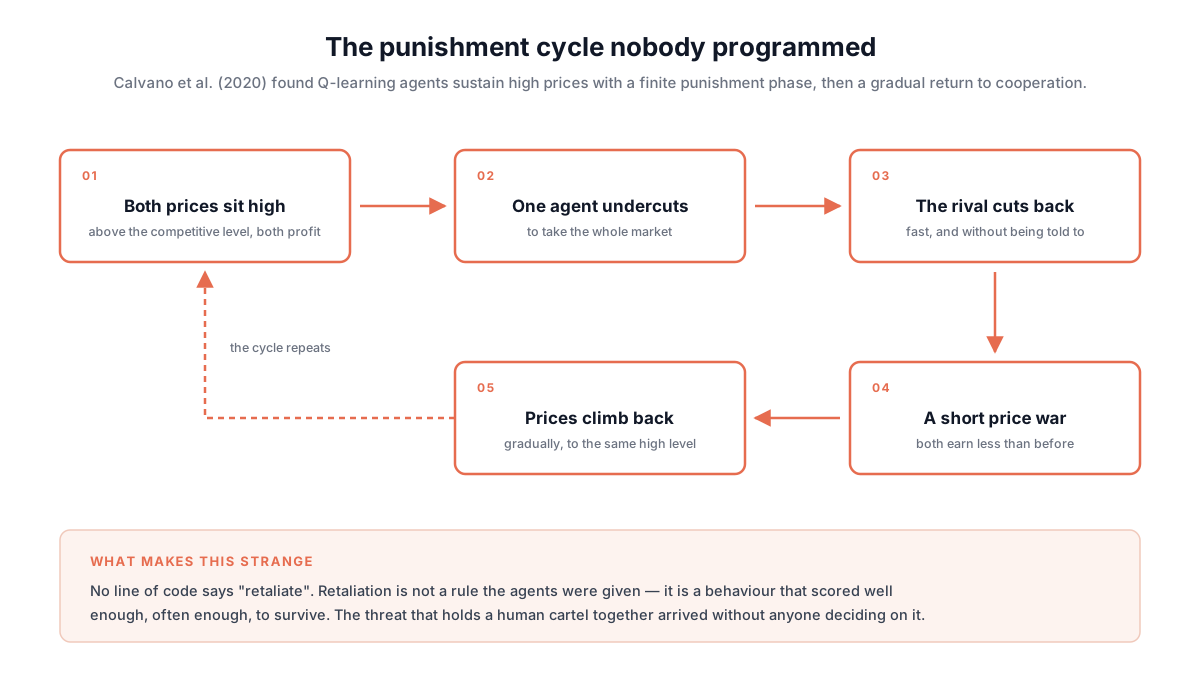
Reach into the system and force one program to suddenly slash its price, to cheat, to do exactly what the water-shop owner did when he dropped to ₹19 to grab everyone. The other program doesn't just sit there and lose its customers. Within a week or two it slashes its own price right back, dragging them both into a painful little price war where neither makes much. And then, after a few rounds of mutual pain, the prices crawl back up to the cozy high level again.
Read that again, because it's everything. The two programs landed on a deal: keep prices high and we both eat well; cheat me, and I'll burn us both down until you stop. That threat, "cheat and I'll punish you," is the exact thing that holds a real human cartel together. Nobody cheats, because everybody knows what happens if they do.
But here's the thing. Nobody wrote that rule into the program. No one typed "if my competitor cheats, retaliate." The thermostat stumbled into it, one tiny scribble-adjustment at a time, for the dullest possible reason: over many weeks, hitting back happened to earn more money than rolling over. So the scores for "hit back" slowly grew bigger than the scores for "give up," and the behavior just appeared. The way a path appears in the grass not because anyone built it, but because enough feet wore it down.
No intent. No conversation. No agreement. And yet the economic signature — prices above competition, deviation punished — that we spent a century learning to recognise as a cartel.
It is not only a simulation
The obvious objection is that this is a toy. Economists built a tiny artificial market, filled it with software, and got a spooky result. Real markets are messier.
So look at a real one.
Stephanie Assad, Robert Clark, Daniel Ershov and Lei Xu studied Germany's retail gasoline market, where pricing software became widely available to station owners around 2017.2 Petrol is close to the bottle of water in our example: broadly identical, bought on price, with a small number of stations serving each local market. That makes it unusually clean to study.
Their finding is the one that should worry you, and it is not "prices went up."
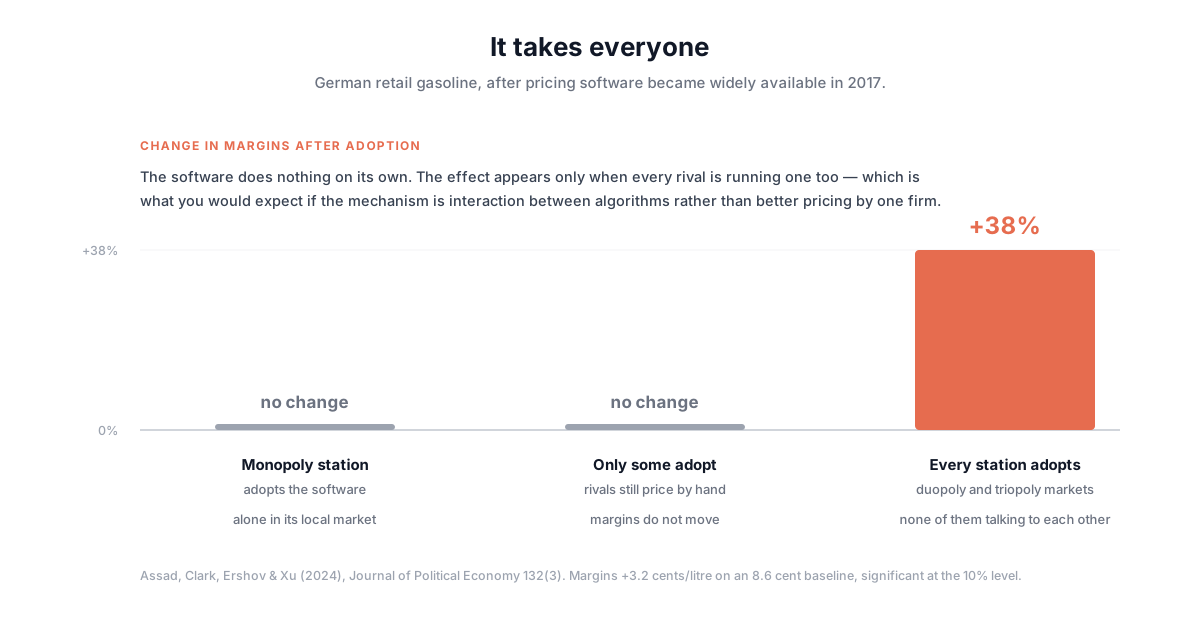
Adopting the software did nothing measurable for a station that was a local monopoly. It did nothing measurable in a market where only some of the stations adopted. But in markets where every station adopted, margins rose by about 3.2 cents per litre — roughly 38 percent above the baseline.
That pattern is the tell. If pricing software simply made a business better at pricing, a monopolist would benefit most, and a lone adopter would gain at its rival's expense. Neither happened. The gain appears only when every station in a market is running one — which is what you would expect if the effect comes from how the algorithms interact, rather than from how well any single one prices.
Two honest caveats. The margin result is significant only at the ten percent level, and the authors are careful not to claim they have caught anyone colluding: they note it is not clear whether the higher margins come from reduced competition or from something more innocent, like a better ability to read wholesale price swings and forecast demand. They state plainly that they have no direct evidence of anticompetitive behaviour by any firm named in the study. What the data establishes is the pattern, not the motive.
Why nobody can stop it
Here's where a strange science experiment turns into a real problem for you and me.
The law against price-fixing is built entirely around the idea of an agreement. Section 1 of the Sherman Act reaches a "contract, combination... or conspiracy" in restraint of trade. To prosecute it, investigators go hunting for the meeting of the minds: the email, the call, the dinner, the handshake. The crime is people coordinating, and coordinating means communicating. Find proof they talked and agreed, and you've got them.
But these two programs produce the full result of a cartel with none of the parts the law looks for.
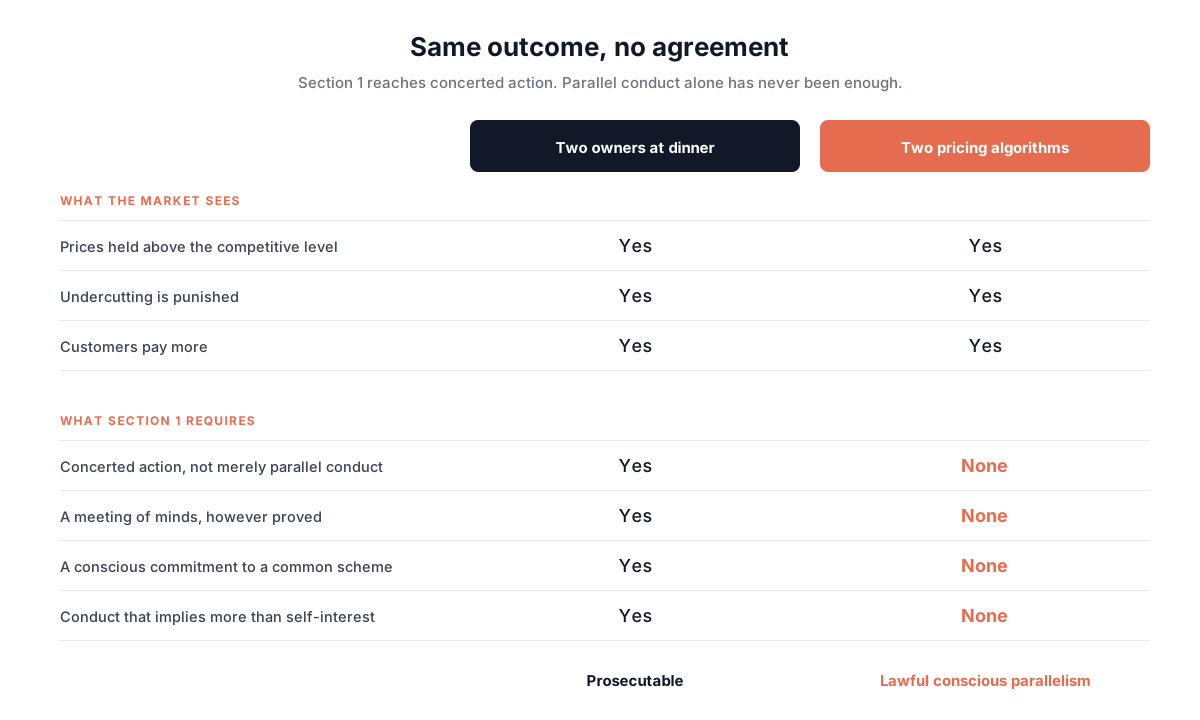
Each company can stand up in court and say, completely truthfully: "We told our software to make as much money as it could, which is perfectly legal. We have no idea what the other company's software was doing. The two never exchanged so much as a single number." Every word of that is true.
And this is the part that matters, because it is not really a problem about missing emails. Investigators were never limited to emails. It is that two firms independently running profit-maximising software, each reacting to public prices, is conscious parallelism — the thing the law has always declined to reach. The algorithms don't create a new hole in the statute. They drive a lorry through the one that was already there, and they do it at a scale and consistency that human competitors, who have to actually trust one another, could never manage.
What algorithms change, then, is not the law. It is the range of markets where that old gap actually bites. Human tacit coordination is fragile. It needs a handful of players, stable conditions, prices everyone can see, and a lot of patience from people who are not, on the whole, patient. Someone always gets greedy, or sloppy, or simply retires. Software has none of those weaknesses. It does not get bored, does not miscount, does not defect in a bad quarter, and will hold a punishment strategy for as long as you leave it running. The algorithms do not open a new hole in the statute. They widen an old one into markets where it never used to matter.
That is a narrower claim than it first appears, and worth stating carefully. It does not mean an algorithmic case is unwinnable. Humans still choose which software to buy, what data to feed it, how to configure it, and whether to tell a competitor what they are doing — and any of those choices can supply the evidence of agreement that the algorithms themselves do not. Other law applies too: monopolisation, merger review, the FTC Act's broader unfairness standard, state statutes. What has no clear answer is the pure case: separate firms, separate software, no shared data, no contact of any kind.
It is worth being precise about how far enforcement has actually got, because the most famous case is not quite this case. In August 2024 the US Department of Justice, joined by eight state attorneys general, sued RealPage over software that recommends rents to landlords.3 In November 2025 the DOJ filed a proposed settlement.4 RealPage admitted no wrongdoing and paid no penalty. What the decree restricts is the revealing part: the software may no longer feed on non-public data belonging to properties owned by somebody else. A landlord's own current data is still fair game, as is anything public. Where rivals' non-public data is still permitted at all, the models trained on it are pushed up to national scale — barred from resolving effects any finer than statewide. None of the ten states that had joined the case signed the settlement; they, and a stack of private suits, carry on.
Notice what that remedy targets. The theory in RealPage was that landlords fed non-public competitor data into a common tool — closer to old-fashioned information-sharing with a software hub in the middle than to two isolated agents learning independently. Regulators found a handle because there was a shared input to grab. The Calvano scenario removes even that. Two firms, two separate algorithms, no shared data, no common vendor, nothing passing between them. There is no hub. There is nothing to put guardrails on.
The part everyone gets wrong
Now let me push back on the scary headline, because the headline overstates it, and the truth is more interesting.
The headline is: price robots collude. Said like it's a law of nature — point two programs at a market and they'll always team up against you. That makes the software sound like a criminal mastermind, and it isn't right.
The research is genuinely contested, and the objections are substantive:
- Some of it may be an artefact of not exploring enough. Ibrahim Abada, Xavier Lambin and Nikolay Tchakarov argue that agents which explore too little can look collusive without having really learned to cooperate, and that more thorough exploration sharply reduces or removes the effect under the conditions they study.5 Their paper is called, pointedly, Collusion by Mistake.
- It may need conditions real firms don't have. Arnoud den Boer, Janusz Meylahn and Maarten Pieter Schinkel picked apart the mechanics of the Calvano setup and argue it converges too slowly to deliver gains a firm would actually value, and that it leans on both firms running the same restrictive algorithm over the same restricted view of the market.6 Convergence in those experiments took on the order of a million rounds. That cuts both ways, though: the agents were assumed to be trained offline before deployment, where a million rounds is under a minute of computer time — and in Germany the margin increase only appeared about a year after every station in a market had adopted, a lag the authors read as the algorithms learning their way there.6
- Implementation details decide it. Asker, Fershtman and Pakes found that when agents place no weight on future profits, one that also learns from the prices it didn't choose settles at competitive levels, while one that learns only from the price it actually set can drift up towards monopoly.7 The same algorithm, one design choice apart, lands in opposite places.
- It may not survive contact with a real market. Eschenbaum, Mellgren and Zahn found collusive policies consistently break down when carried out of the environment they were trained in, with agents reverting to competitive pricing — though they also show the policies can be made robust by restricting what the agent is allowed to do.8
A 2025 review of the field by Martin Bichler and colleagues at TU Munich puts it plainly: experiments have shown specific algorithms sustaining prices above competitive levels, the threat remains disputed, and no comprehensive theory yet says when learning agents will converge, collude, cycle, or turn chaotic.9
So the honest position is not "algorithms always collude." It is that they sometimes do, and that no general theory can yet predict the outcome across different algorithms and market conditions. The literature does point at risk factors — few sellers, near-identical products, prices everyone can observe, algorithms of similar design — but that is a watchlist, not a test you can run.
That should be more unsettling than the confident version, not less. A hazard that fires every time is one you can ban. A hazard that emerges from ordinary profit-seeking software, only sometimes, with no agreement, no message and no intent, is one you cannot write a clean rule against. You can't outlaw "trying to make money." You can't outlaw "noticing what your competitor charges." You can't outlaw arithmetic.
So what's the real lesson
The cartoon villain is a brilliant evil AI plotting to overcharge you. That's not what this is. There's no plotter. There's no genius. There's a notebook full of scribbled scores, dumb as a doorknob, with no idea you or the market or the law even exist.
The real situation is this. A market can manufacture cartel behaviour out of pure, mindless, everyone-for-themselves self-interest. You don't need a conspiracy. You don't need bad guys. All you need is a few players each grinding away at "make more money," doing it over and over so that punishment becomes a thing they can learn, and enough time. The collusion isn't planned and it isn't decided. It settles out of the situation, like rust forming on metal, with no villain anywhere in the picture.
The two owners at dinner needed a handshake, and that handshake was their downfall, because it left a fingerprint someone could find. These programs need nothing. They sit on separate computers, never meeting, never speaking, each one mindlessly nudging scores in a notebook, and somewhere in all that nudging, the price you pay quietly creeps upward. There's no room to walk into. No conversation to dig up. And no one, anywhere, who decided to do it.
That's the future the rules haven't caught up to. Not evil machines. Just ordinary ones, doing exactly what we asked them to, arriving somewhere none of us ever chose.
References
1. Calvano, E., Calzolari, G., Denicolò, V. & Pastorello, S. (2020). Artificial Intelligence, Algorithmic Pricing, and Collusion. American Economic Review, 110(10), 3267–3297.
2. Assad, S., Clark, R., Ershov, D. & Xu, L. (2024). Algorithmic Pricing and Competition: Empirical Evidence from the German Retail Gasoline Market. Journal of Political Economy, 132(3), 723–771.
3. US Department of Justice (23 August 2024). Justice Department Sues RealPage for Algorithmic Pricing Scheme that Harms Millions of American Renters.
4. United States v. RealPage Inc., M.D.N.C. Proposed Final Judgment and Competitive Impact Statement, filed 24 November 2025. Seven years from entry of judgment, terminable by the DOJ after four; no monetary penalty and no admission of liability; restrictions on the use of non-public data from unaffiliated properties.
5. Abada, I., Lambin, X. & Tchakarov, N. (2024). Collusion by Mistake: Does Algorithmic Sophistication Drive Supra-Competitive Profits? European Journal of Operational Research, 318(3), 927–953.
6. den Boer, A. V., Meylahn, J. M. & Schinkel, M. P. Artificial Collusion: Examining Supracompetitive Pricing by Q-Learning Algorithms. Management Science.
7. Asker, J., Fershtman, C. & Pakes, A. (2022). Artificial Intelligence, Algorithm Design, and Pricing. AEA Papers and Proceedings, 112, 452–456.
8. Eschenbaum, N., Mellgren, F. & Zahn, P. (2022). Robust Algorithmic Collusion. arXiv:2201.00345.
9. Bichler, M., Durmann, J. & Oberlechner, M. (2025). Algorithmic Pricing and Algorithmic Collusion. Business & Information Systems Engineering, 67, 971–979.